
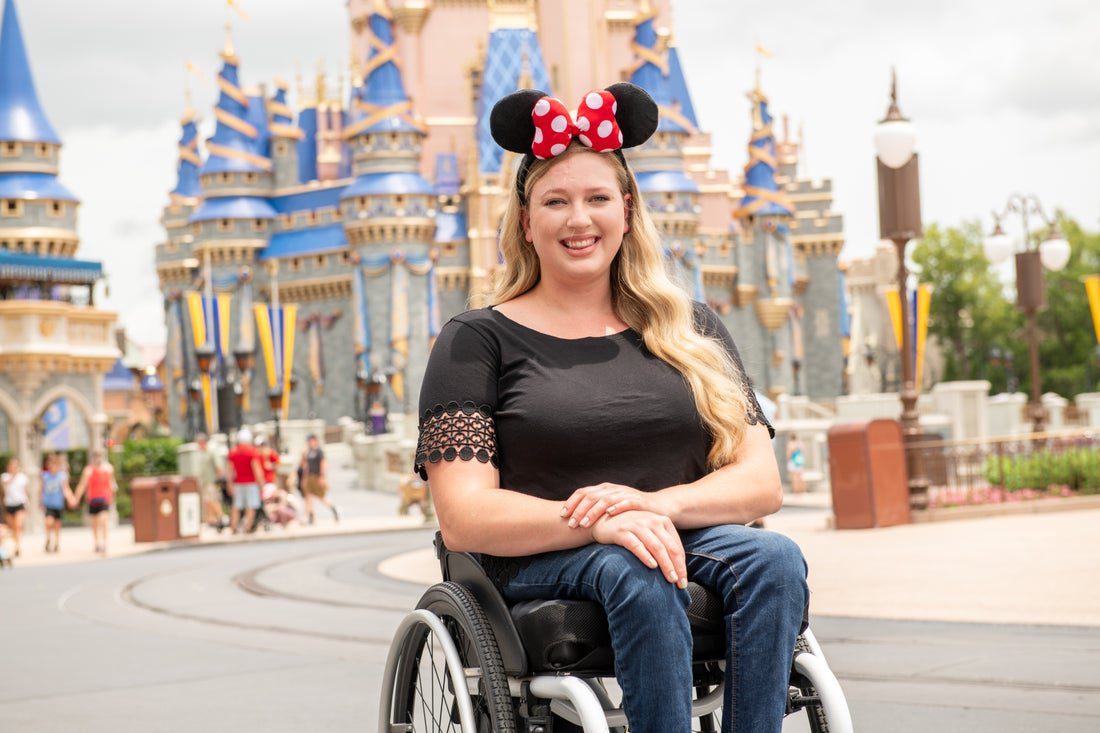
A note before we get into this: we’re a travel agency, not a family with personal lived experience using a wheelchair at Disney. Most of what’s in this guide comes from planning these trips for client families and from the conversations those families have shared with us during and after the trip. Wherever something below would be better answered by a wheelchair user themselves, we say so. There are excellent first-person guides out there — we’ll point to a few at the end. What we can offer is the professional planner’s view: what works, what trips up first-time families, and what we wish more agents told their clients before booking.
If you’re planning a Walt Disney World trip with a child or teen who uses a wheelchair — whether manual, power, or an ECV (Electric Convenience Vehicle) — here’s what we’ve learned matters most.
The Big Picture: Disney Is Genuinely Accessible. The Rest Is Logistics.
Disney World is one of the more accessible large entertainment venues you’ll ever visit. The infrastructure is real: every ride queue, restaurant, restroom, transportation hub, and resort has been designed with wheelchair access as a baseline expectation, not an afterthought. Most attractions have either fully accessible queues or alternate boarding processes. Park transportation accommodates wheelchairs and ECVs. The cast members are trained on accessibility protocols and, in our experience, are consistently helpful when asked.
That said, “accessible” doesn’t mean “easy.” A wheelchair-using guest navigating Disney still encounters challenges that an able-bodied guest doesn’t have to think about. The crowds, the heat, the distances, the queue logistics, the transportation logistics, and the sheer length of the day all combine in ways that can make a Disney trip extraordinary for a wheelchair user — or exhausting and frustrating, if the planning hasn’t accounted for the right things.
The difference between a great trip and a hard one is almost always in the planning.
Decision One: Bring Your Own Equipment, or Rent at Disney?
This is one of the first decisions families ask us about, and the answer depends on your situation more than on Disney.
Bringing your own wheelchair or ECV
The advantages are real: it’s the chair your child or teen knows, fits, and uses comfortably every day. Custom seating, headrests, harnesses, and tilt mechanisms come with you. There’s no logistics around pickup or return.
The downsides are mostly travel-related. Air travel with mobility equipment is its own significant project — power wheelchairs in particular need careful airline coordination, including documentation of battery type, weight, and dimensions. Damage to mobility equipment during air travel is unfortunately common, and Disney isn’t responsible for fixes if the chair arrives broken or gets damaged on a Disney bus.
If you’re driving to Disney, bringing your own equipment is almost always the right call. If you’re flying, it requires more planning but is still usually worth it for power wheelchair users with custom seating needs.
Renting at Disney or off-property
Disney rents standard manual wheelchairs and ECVs at every park ($12-$70/day depending on type), but they’re first-come first-served and don’t always last through busy mornings. Returns happen at the park you rented from, which is inconvenient if you’re park-hopping.
For most families, third-party off-property rental companies are a better option. They deliver the equipment directly to your resort, you have it the entire stay, and you return it at the end. The four most-used in our experience are ScooterBug (Disney’s official partner), Buena Vista Scooters, Walker Mobility, and Gold Mobility Scooters. ScooterBug has the simplest delivery process because of the official partnership; the others sometimes require a bell services rendezvous for delivery.
For children too small for a standard wheelchair, options narrow significantly. Pediatric wheelchair rentals exist but are limited. Many families bring a stroller-as-wheelchair (more on that below) or rent specialized pediatric equipment from medical supply rental companies that ship to your hotel.
The Stroller-as-Wheelchair Tag (Crucial for Younger Kids)
If your child is small enough to use a stroller but uses a wheelchair due to mobility, sensory, or medical needs, request a Stroller-as-Wheelchair tag from any Guest Relations location at any Disney park. This tag attaches to your stroller and signals to cast members that your stroller serves the same function as a wheelchair.
What this gets you:
- Permission to bring the stroller into ride queues that don’t normally allow strollers
- Permission to bring the stroller into shows, restaurants, and indoor venues
- Treatment as a wheelchair user for boarding accommodations on rides where it matters
This tag is free, takes five minutes to obtain, and is one of the most underused accommodations at Disney. If your child uses a stroller for mobility-related reasons, do not skip this. Most first-time families don’t know it exists.
Disability Access Service (DAS) and Wheelchair Users
Here’s a clarification that families often get wrong: using a wheelchair does not automatically qualify a guest for DAS. DAS is intended for guests who cannot wait in a standard queue due to a developmental, neurological, or other non-mobility-based disability. Most wheelchair-using guests do not qualify for DAS based on the wheelchair alone, because most ride queues are now wheelchair-accessible.
That said, many wheelchair users do qualify for DAS for separate reasons — autism, intellectual disability, anxiety disorders, medical conditions that prevent extended waiting, etc. If your child or teen has a condition that makes traditional queue waiting impossible (regardless of the wheelchair), they may qualify, and the DAS interview is the right path to explore.
For the full qualification rules and registration process, see our complete DAS guide →
If your child uses a wheelchair and has another qualifying condition, lead the DAS interview with the qualifying condition, not with the mobility piece. The interview is structured around “why can’t this guest wait in a standard queue?” — and the answer “because they use a wheelchair” usually leads to a denial because Disney’s standard queues accommodate wheelchairs.
If your child also has autism, here’s what we’ve learned in 10 years of DAS →
Queue Access and Boarding: What Actually Happens
Here’s how queues work for wheelchair users at Disney World today:
Most queues are fully wheelchair accessible. You wait in line with everyone else, in the same line, and the queue accommodates your wheelchair throughout. This is true for the vast majority of attractions, including newer ones like Avatar Flight of Passage, Tron Lightcycle Run, and Guardians of the Galaxy: Cosmic Rewind.
Some queues have alternate accessible entrances. A small number of older attractions have separate accessible entrances that bypass the standard queue. Cast members at the queue entrance will direct you. Wait times for the accessible entrance are sometimes the same as the standard queue, sometimes shorter, sometimes (paradoxically) longer if a previous guest is being loaded.
For some rides, transferring out of the wheelchair is required. Roller coasters and high-thrill attractions almost always require the guest to transfer to the ride vehicle. If your child or teen cannot transfer independently, family members can help — but be aware that some rides require independent transfer with no assistance from cast members. This is a safety policy, not negotiable.
For a few attractions, accessible ride vehicles allow guests to remain in their wheelchair. These are the easiest rides for non-transferring wheelchair users:
- The Many Adventures of Winnie the Pooh
- Buzz Lightyear’s Space Ranger Spin
- Living with the Land
- Spaceship Earth (with assistance)
- Finding Nemo: The Big Blue and Beyond
- Kilimanjaro Safaris (the ride vehicle accommodates wheelchairs)
- Na’vi River Journey
This list is not exhaustive and can change. Disney’s official Walt Disney World accessibility documentation has the current and complete information for every attraction.
Resort Choice for Wheelchair Users
Resort choice matters more for wheelchair users than for most other guests. A few considerations:
Room type. Every Disney resort has accessible rooms with roll-in showers, lower vanities, grab bars, and accessible toilets. Book the accessible room directly through Disney or your travel agent — don’t assume a standard room will be “close enough.” Disney’s accessible rooms are limited and book up early; if you wait until 30 days out, the inventory may be gone.
Accessible rooms are one of the booking-window advantages of staying on Disney property — here’s how the full Disney booking timeline works →
Property layout. Some Disney resorts are sprawling. Coronado Springs and Caribbean Beach are large and may require multiple bus stops just to get from your room to the lobby. Port Orleans Riverside and Caribbean Beach are also boat-transportation-friendly resorts but use small boats that are less wheelchair-accessible. For wheelchair users, more compact properties (Pop Century, Art of Animation, Contemporary, Polynesian, Wilderness Lodge) often work better despite being more expensive in some categories.
Transportation type. Resorts vary by transportation method:
- Monorail resorts (Polynesian, Grand Floridian, Contemporary): excellent for wheelchair users; monorails accommodate wheelchairs easily.
- Skyliner resorts (Riviera, Caribbean Beach, Pop Century, Art of Animation): the Skyliner gondolas accommodate ECVs and wheelchairs but require the chair to fold or, for some types, to roll directly into the gondola. Worth confirming with current Skyliner cast members for specific equipment.
- Boat-only resorts to certain parks: small boats are often not wheelchair-accessible. Family will need to use bus alternative.
- Bus-based resorts (most others): Disney buses have wheelchair lifts and securements. Loading takes longer (usually 5-10 minutes per wheelchair), so build that time into your day.
Pool accessibility. Most Disney pools have zero-entry sections or pool lifts. Confirm specifics with your resort before booking if pool time is important.
Military families weighing Shades of Green should know its accessibility profile is different from a Disney resort — fewer accessible room types, no resort-direct bus service, and a longer walk or shuttle to the parks. We compare Shades of Green vs. a Disney resort here →
The Heat, The Crowds, and the Day Length
Three logistical realities worth planning for honestly:
Florida heat is brutal for power wheelchair users. Heat affects battery performance, can cause skin breakdown for users with sensitivity, and increases risk of dehydration for users on certain medications. For a Florida summer trip, plan to be back at the resort during the 1-4 PM heat window every day, no exceptions. For shoulder-season trips (October-December, February-April), the heat is more manageable but still real.
Crowds are the wheelchair user’s enemy. Navigating peak-crowd Magic Kingdom on a Saturday in spring break with a wheelchair is genuinely difficult. Other guests do not always see the wheelchair, parents push strollers backward into your space, and queue lines wind tightly. Travel during off-peak times if you can possibly arrange it. Mid-September, mid-January (after MLK weekend), and the first two weeks of December are dramatically easier on wheelchair users than spring break or summer.
Day length matters. A 12-hour Disney day is exhausting for everyone. For wheelchair users — especially manual chair users who are self-propelling, or users with conditions that fatigue easily — that day is twice as long. Build in genuine rest, not “let’s just sit at this restaurant for a while.” Plan to be back at the resort by 1-2 PM most days.
Things Other Guides Skip but Matter
A few specific tips that come up in our planning conversations and rarely make the standard guides:
- Charge power chairs and ECVs every night without fail. Outlets in resort rooms are typically near the bed. Bring your charger; don’t assume the resort has spares.
- Water is your friend; bring or buy more than you think you need. Disney allows guests to bring their own water bottles into the parks. Free cups of ice water are available at every quick-service restaurant.
- Companion restrooms are everywhere. These are large single-occupancy rooms with full accessibility, often quieter than standard restrooms. Cast members at any location can direct you to the nearest one.
- The Disability Access Service interview now happens via video before your trip. Schedule it at least 30 days before your travel date. The slot system fills up.
- Confirm dining accessibility when booking reservations. Most Disney restaurants are wheelchair-accessible, but a few (especially older ones in resort villages) have steps or narrow turns. Mention the wheelchair when booking so dining can flag any concerns or assign an appropriate table.
- Plan your park bag around your child’s specific needs, not Disney’s generic recommendations. Medications, suction equipment, feeding tube supplies, communication devices, sensory items — these are not optional. Build a list, double-check it, and pack a backup in a separate bag.
A Word on Disney Cast Members
This is the part that most surprises first-time families: Disney cast members are, in our experience, consistently exceptional in their handling of wheelchair-using guests. They are trained on accessibility protocols, they know the queues, they know which rides accommodate what, and they will go meaningfully out of their way to make your trip easier when asked.
Two practical implications:
- Ask early and ask often. If you’re unsure whether your child can ride something, whether a queue is accessible, or whether an accommodation is available — ask the nearest cast member. The answer is almost always yes, or here’s what we can do instead.
- The cast members are the last line of defense against a frustrating moment. If something is going wrong — a queue that’s harder than expected, a ride that turns out to be inaccessible after a long wait, an attraction that’s down — the cast members are empowered to make it right. Speak up, kindly, and let them help.
What We Wish More Families Knew Before Booking
The single most common thing first-time families say to us after a Disney trip with a wheelchair user: “We wish we’d booked an accessible room from the start.” The standard rooms can technically be made to work, but they make the trip harder than it needs to be. Book the accessible room.
The second most common: “We wish we’d built more rest into the schedule.” Disney’s marketing makes you feel like you should pack every hour. For a wheelchair-using family, you cannot. Plan less, rest more, and enjoy what you do.
The third: “We wish we’d asked more questions before booking.” Resort choice, room type, transportation logistics, dining accessibility, ride compatibility — these are not things to figure out on day one of the trip. Work with someone (your travel agent, a community of other wheelchair-using Disney families, a dedicated accessible travel resource) who can help you front-load the decisions before you arrive.
First-Person Resources
Because this guide is written from the planner’s perspective, here are several first-person guides written by wheelchair users and their families that we point clients to:
- Disabled Disney Travelers (Facebook group) — active community of wheelchair users sharing real-time tips
- The Disney Disability Group (Facebook group) — broader accessibility community including wheelchair-specific discussions
- Wheelchair Travel (wheelchairtravel.org) — Cory Lee’s site is the definitive accessible travel blog, with detailed Disney coverage from a power wheelchair user’s perspective
- Mobility International USA — broader resources for travelers with disabilities
Their voices on this topic are more authoritative than ours could ever be. We point clients to them all the time.
How We Help
We’ve planned Walt Disney World trips for many families with wheelchair users — children, teens, and adults. We don’t claim lived experience with wheelchair travel, but we’ve built deep familiarity with the logistics: accessible room booking, transportation strategy, ride and dining selection, equipment rental coordination, and the pacing decisions that make the trip work.
If you’re planning a trip and want someone in your corner who’s done this work before, we’re here. Our planning is free, we’re veteran-owned, and we listen first. We’ll also tell you honestly when we think you’d be better served by a different resource, because the goal is your trip working — not our commission.
Jinni Vacations is a veteran-owned travel agency in Southeast Michigan specializing in Disney World, Disneyland, and Disney Cruise Line vacations for military families and families traveling with accessibility, sensory, or special needs. Information in this post is accurate as of April 2026 and may change. Always verify current accessibility policies with Disney directly when planning.
What about traveling with a family member with autism, mobility needs, or dietary restrictions?
Related Posts
Disney World With an Autistic Teen or Adult: A Sensory Survival Guide
Most of what's written about visiting Disney World with autism…
Disney’s Disability Access Service: Complete 2025-2026 Guide
Planning a Disney trip with a family member who has…
Disney With an Autistic Child: What 10 Years of DAS Taught Us.
Our son is 18 now. We've taken him to Walt…